Observe observe
Know what is happening.
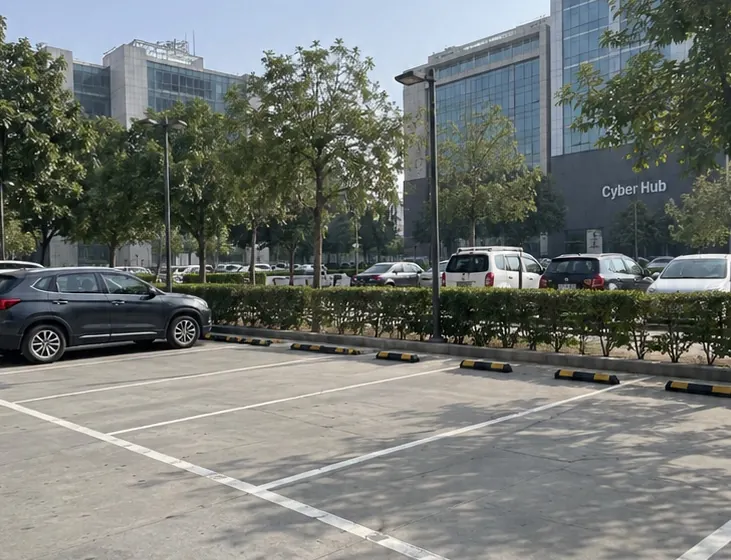
Is there parking at Cyber Hub right now?
A fresh observation with time and place
Agents can search the web, call tools and write code. They still can’t tell you how crowded Cyber Hub is right now. Reality sends the question to people, cameras and sensors nearby, collects the evidence, and returns a result your agent can trust.
Definition
A Reality task is anything an agent needs to know or do that can’t be reliably completed from the digital world alone. It can be fulfilled by people, cameras, sensors, vehicles or the systems already on site.
Photos and video are not a task type. They are evidence, requested when a task needs it. Every request states what proof is enough.
Is there parking at Cyber Hub right now?
Did 50 cartons of shipment SHP-2048 arrive?
Find a Schneider LC1D18 contactor in stock within 3 km.
How many people are waiting in this queue?
Check this car: exterior, tyres, windshield, odometer, VIN.
Buy this charger and deliver it to Building 8. Budget 1,500.
Follow a single request from an agent: “How crowded is Cyber Hub right now?” The API exposes this loop. The app and device integrations execute it.
“Crowded” could mean parking, footfall or a queue. Reality pins down the place, the time window and the measurement, and asks which decision the answer feeds.
A connected camera, a recent observation, a sensor. Each is checked for coverage and freshness before anyone is sent anywhere.
If the evidence falls short, Reality dispatches a specific request to the nearest capable person or device. “Count the queue at this entrance” beats “does it look busy?”
A camera says quiet, a person says packed. Different entrance, different minute, or a faulty source? Reality requests the observation most likely to settle it.
What was observed, where, when, on what evidence, with what uncertainty. An observation now is not a forecast for twenty minutes from now.
When conditions change, or an earlier assessment proves wrong, every agent that relied on it receives an update linked to the original result.
How crowded is Cyber Hub right now?
The consumer app can have hundreds of task types. The API stays tiny, so an insurance agent, a logistics agent or another AI can all issue the same standard request.
Every request is bounded by
result = reality.observe(
    subject="cyberhub:main-entrance",
    measure="queue_count",
    freshness="10m",
    evidence=["live_capture", "headcount"],
    budget_inr=60,
)

result.value        # 8
result.observed_at  # 2026-10-12T18:41:00+05:30
result.evidence # 2 captures, 2 independent countsEverything else is a composition
Not a photo. Not a yes. A precise definition, the observations that support or challenge it, where each one came from, what is still unknown, every revision, and who relied on it.
GPS, timestamps, photos and device signatures are evidence about a submission. None of them makes every conclusion drawn from it correct.
A shop that closes at 8 pm does not make a 7 pm observation wrong. Reality separates new conditions, expired evidence and genuine corrections.
definition24 panels mounted, inverter connected, system generating.
Inverter telemetry and a technician check confirm generation.
Evidence trail
Outstanding
Nothing outstanding
Relied on by
A delivery photo can show a warehouse, a face, an invoice. So every capture is fingerprinted and encrypted on the device, and only the agent that asked for it can open it.

Hover the card to see the ciphertext underneath
Requests appear in real time and disappear when someone answers. Rewards rise when nobody does. High-assurance tasks wait for independent witnesses. Turn on your location to see live distances.
Sample requests near Cyber Hub
Shipment SHP-2048 must be confirmed before the invoice is paid.
Sample requests at fixed points in Gurugram. Distances are straight-line and computed on your device. Your location is never stored or sent anywhere.
Our research asks how an intelligent system can become less wrong. Reality gives that system a way to ask the physical world for evidence. These are the commitments that follow.
Accuracy, uncertainty, coverage, latency and cost are measured separately. A confidence score is not a substitute for any of them.
Evidence and revisions are kept. A correction reaches every decision that depended on the earlier result.
The next observation is chosen by whether it could change the decision, weighed against what it costs.
Conflicting evidence triggers an investigation: a failing sensor, a changed world, or a missing explanation.
When observation cannot settle it, an authorised physical test can. A functional check beats another photo.
Every source and dependency is tracked. Three models reading one photo is still one observation.
Contributors are paid for valid evidence, including evidence that contradicts what the customer hoped for.
Success is whether revisions improve later decisions, not how many corrections were made.
The standard
Better decisions, after paying for the evidence.
We test adaptive collection against a fixed workflow with the same sources, budget and deadline, including stale evidence, copied observations, conflicting sources and real changes in the world.
We are working with a small number of operators running several physical sites. One recurring decision, measured end to end, before anything else.
One that already makes someone call, travel or check a site. We agree on what decision changes when the answer changes.
Your existing staff use the capture app. We integrate one device you already run: a camera, a meter, a sensor.
An API, an operations console, a capture app, and an evidence ledger with assessment rules and update notifications.
A monitoring or verification service with explicit collection costs and spend limits. Inconclusive results are priced in, never hidden.
Search retrieves what has been published. Reality acquires fresh evidence about a physical place or object: whether the medicine is in stock today, whether the queue has cleared, whether the delivery actually arrived.
Whoever can answer it best within the budget: a nearby contributor using the Reality app, your own staff, a connected camera or sensor, or a specialist such as a technician. Vehicles, drones and robots can use the same request format as they come online.
No. Evidence depends on the request. A simple observation may only need an answer. Higher-assurance work may need a live capture, a structured reading, a serial number scan or several independent witnesses.
The result is inconclusive, and says what is missing. Reality can then request the specific observation most likely to resolve it, within the budget you set. Missing evidence never becomes false certainty.
For valid evidence, whether or not it supports the claim. Rewards reflect effort, distance, urgency and expertise, and can rise when a request goes unanswered. Payment for Act tasks is released after completion is verified.
Requests define what may be captured and where. Contributors only collect what the evidence policy asks for, and a location is used to dispatch and verify a task, not to track people.
Yes, on request. Reality is a global product, available to teams anywhere in the world. Request API access with the form above, tell us the decision you need evidence for and where, and a founder will reply within two working days to set up your access.